
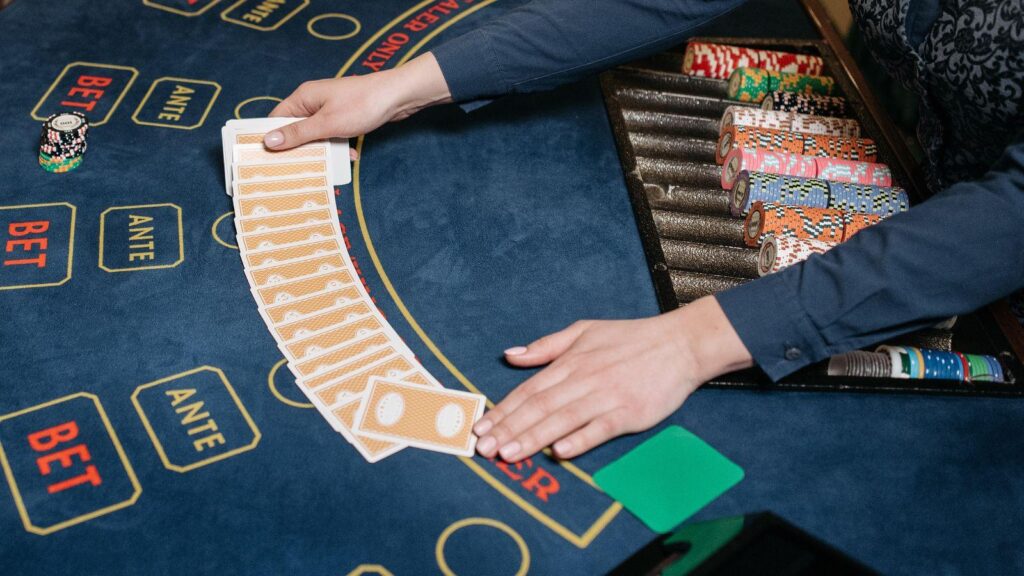
Most players who sit down at a table game already know the odds don’t change. And yet — they still raise their bet after three losses in a row, convinced something is about to shift. That gap between knowing and doing is exactly where variance does its most interesting work.
Researchers studying decision-making under uncertainty — including work from behavioural economists like Daniel Kahneman and Amos Tversky — consistently find that the human brain is wired to treat recent outcomes as predictive signals, even when they carry zero predictive value in genuinely random systems. In a roulette session or a blackjack run, every hand resets from scratch. The math doesn’t accumulate. The player’s emotional state, though? That absolutely does.
Why Your Brain Lies About What Just Happened
Modern digital entertainment platforms like Betnation Casino deliver seamless, immersive gameplay designed to make every session exciting, but understanding how the brain processes short-term momentum helps players enjoy the thrill while staying in full control.
Short-term session outcomes feel like feedback. A stretch of three winning hands doesn’t mean your read on the table is sharpening — it means variance handed you something statistically unremarkable, and your brain immediately filed it under “I’m figuring this out.” Researchers at the University of Cambridge studying gambling cognition have documented how near-misses and short streaks activate the same reward pathways as actual wins, which means the emotional response doesn’t always match the financial reality.
Tilt — that slightly unhinged mental state where frustration takes the wheel — kicks in faster than most players expect. A session that turns bad within the first twenty minutes doesn’t feel like randomness. It feels personal. And that’s where the impulse to recover quickly starts overriding whatever bankroll plan existed before the session started. Loss aversion, one of the most replicated findings in behavioural science, means players feel a loss roughly twice as sharply as an equivalent win. So a £50 gain followed by a £50 loss doesn’t feel neutral. It feels like a net negative. The session feels broken even when it’s mathematically flat.
Habit Loop That Keeps Players at the Table
Habit loops form quietly and almost never announce themselves. A player who once turned a losing session around by doubling their bet at the right moment doesn’t remember all the times that move failed — they remember the one time it worked. Brilliantly. That memory becomes a template. The brain stores it not as a lucky fluke but as a transferable strategy, which is precisely why systems like Martingale or “feel-based” timing adjustments keep circulating despite having no edge over flat betting in random variance environments.
The perceived control illusion runs deep. Changing bet sizes, switching tables, adjusting timing — none of these actions alter the underlying probability of a card game or a roulette spin. But they create the sensation of agency. And agency, even illusory, reduces anxiety. Researchers studying cognitive bias in gambling environments note that players report feeling “more in control” after making a strategic adjustment, even when the outcomes following that adjustment are statistically identical to what came before.
What Variance Actually Looks Like Across a Session
It helps to see what typical session swings look like compared to what players tend to interpret them as:
|
What the session shows |
What the math says |
What the player usually concludes |
|
Three wins in a row early on |
Normal variance — happens roughly 12% of the time in even-money games |
“I’m reading the table well, time to push” |
|
Five losses spread unevenly over 30 minutes |
Still within normal distribution — not a signal of anything |
“Something’s off, I need to change my approach” |
|
A near-miss on a high-stakes hand |
Statistically identical to a regular loss in outcome terms |
“I was so close — one more hand and I’ll get there” |
|
Slow, grinding drain over a long session |
Consistent with expected house edge over volume |
“I just need one good run to recover the whole thing” |
The mismatch between column two and column three is where bankroll discipline gets absolutely shredded. Players aren’t making bad decisions because they’re bad at math. They’re making emotionally coherent decisions in response to stimuli that their brains are misreading as meaningful data.
The Specific Triggers That Push Players Into Riskier Choices
Not all emotional triggers hit with equal force. Some are obvious — a big loss on a hand you were sure about. Others are subtler and maybe more dangerous for exactly that reason. Here are the main triggers researchers consistently identify as driving variance misreads:
- Near-misses — where the outcome was almost a win, which fires the brain’s reward system almost identically to actual wins
- Hot streaks — three or four positive outcomes that get mentally coded as a “pattern” even in a fully random sequence
- Slow drain — the gradual, low-drama loss that doesn’t trigger an alarm until the bankroll is already significantly down
- The “deserved win” feeling — which honestly makes no mathematical sense but feels incredibly real after a run of losses
- Early session momentum — winning fast at the start creates an inflated baseline that makes later neutrality feel like failure
Each of these triggers pushes players toward riskier decisions than the underlying odds would ever justify. And here’s the thing — Betnation and similar platforms aren’t engineering these responses deliberately. Variance does that entirely on its own. The game doesn’t need help making sessions feel more dramatic than they mathematically are.
Bankroll behaviour under these conditions follows a recognisable pattern, which researchers studying player psychology have broken down into several recurring decision points:
- Initial plan — the stake limit or session budget set before play begins
- The “still ahead” exception — where early profits justify raising stakes outside the original plan
- The recovery pivot — where losses prompt escalating bets to close the gap faster
- The abandon — when the session collapses quickly enough that the original plan feels irrelevant
Discipline competes with impulse at every single one of those points. And impulse wins more often than players remember afterward.
Reading Variance as Skill Feedback Is a Reliable Way to Misread Everything
Overconfidence after a winning session is almost as costly as panic after a losing one — just slower to reveal itself. A player who runs hot for forty minutes on a blackjack table on a non-reputable site and walks away convinced they “read the variance well” is carrying a false data point into their next session. That belief will shape their opening bets, their risk tolerance, and probably their bankroll management. All based on something that a fair coin could have produced.
The same logic runs in reverse. A rough session doesn’t mean your decision-making was poor. It might mean exactly that — but variance alone cannot tell you which one it was. The discomfort of not knowing, of sitting with genuine randomness as the only explanation, is something the human brain resists almost physically. It wants a cause. It will manufacture one if necessary.