

For parents who need more than weekly support but can’t step away from their families, depression therapy NJ options at Wellness Hills in Chester offers a structured clinical pathway that can be considered alongside caregiving responsibilities. The appropriate level of care depends on each parent’s symptoms, functioning, safety, and clinical needs.
Why a Parent’s Depression Is a Household Issue
Depression can change how a parent experiences everyday life. Energy may be limited, while activities that once felt manageable may require significant effort.
Concentration and decision-making can become more difficult. Irritability or withdrawal may also affect communication and connection within the household.
Children may not understand depression as a clinical condition, but they can notice changes in a parent’s availability, mood, routines, or interactions. That doesn’t mean a parent has failed. It means parental mental health is one part of the wider family environment.
The Two Responses Parents Usually Have
Two common thoughts can compete with one another.
One is, “I will push through for my kids.”
The other is, “I will wait until the children are older.”
Both responses are understandable. Parents often place their children’s needs ahead of their own.
Yet postponing treatment doesn’t necessarily address the underlying condition. Simply forcing oneself through persistent symptoms can also become increasingly difficult when depression is already affecting energy, sleep, concentration, or daily functioning.
Key Takeaway: Depression is a household issue. Parents don’t have to choose between caring for their family and caring for their mental health. Structured outpatient treatment can fit around caregiving responsibilities.
What Depression Treatment Actually Looks Like for a Parent
Depression treatment doesn’t automatically mean leaving home for weeks or entering an inpatient setting.
At Wellness Hills Mental Health in Chester, NJ, depression care begins with a clinical and psychiatric evaluation. The center’s depression program describes care overseen by licensed psychiatric providers and individualized treatment planning for conditions including major depressive disorder, postpartum depression, and bipolar depression.
Care is delivered by a multidisciplinary team including a Board Certified Psychiatrist and licensed therapists.
That evaluation matters because depression can look different from one person to another. A parent struggling with persistent symptoms while continuing to work and care for children may have different treatment needs from someone experiencing a significant decline in daily functioning.
The question is therefore not simply whether a parent “needs therapy.” It’s what type and intensity of care is clinically appropriate.
The Levels of Care at a Glance
● Standard outpatient care: Lower level of structure, such as scheduled individual therapy, with the rest of the week available for work, parenting, and other responsibilities.
● Intensive Outpatient Program (IOP): More frequent clinical support while allowing a person to remain at home. Wellness Hills describes depression IOP schedules that provide several hours of structured treatment without an overnight stay.
● Partial Hospitalization Program (PHP): Greater degree of daytime structure. Several hours of treatment on multiple days each week, returning home rather than remaining in a residential setting.
● Inpatient care: For severe depression or safety concerns requiring continuous supervision. Outpatient providers can help coordinate placement with an appropriate higher level of care.

The Therapies Used
Treatment can involve more than one therapeutic approach.
● Cognitive Behavioral Therapy (CBT): Helps examine patterns of thinking and behavior that may contribute to depressive symptoms.
● Dialectical Behavior Therapy (DBT): Structured skills for emotional regulation, distress tolerance, and behavioral responses. Wellness Hills describes DBT skills for depression, including emotion regulation and opposite action.
● Motivational Interviewing: Helps explore ambivalence and strengthen motivation for meaningful changes.
● Mindfulness practices: Develop greater awareness of thoughts, emotions, and present-moment experiences.
● Group therapy: Structured opportunities to practice coping skills and receive feedback in a clinician-led setting.
● Medication management: Antidepressant medications such as SSRIs and SNRIs when clinically appropriate, based on psychiatric evaluation.
When a Parent Needs More Than Weekly Therapy
Weekly therapy can be an appropriate starting point for some people. For others, symptoms may continue to interfere with family life, work, sleep, relationships, or basic routines despite regular sessions.
The National Institute of Mental Health recommends seeking professional help when depressive symptoms persist or interfere with daily activities. Treatment may include psychotherapy, medication, or a combination of approaches.
Seeking professional care doesn’t mean putting family responsibilities aside. In many cases, it means finding a level of treatment that addresses the parent’s mental health while considering those responsibilities.
A parent may benefit from discussing a more structured level of care with a qualified mental health professional when patterns such as these become persistent:
● Stalled progress despite consistent weekly therapy
● Declining functioning at home or work
● Increasing isolation from family and friends
● Significant disruption to normal sleep patterns
● Loss of established household routines
● Frequent periods of distress that disrupt family functioning
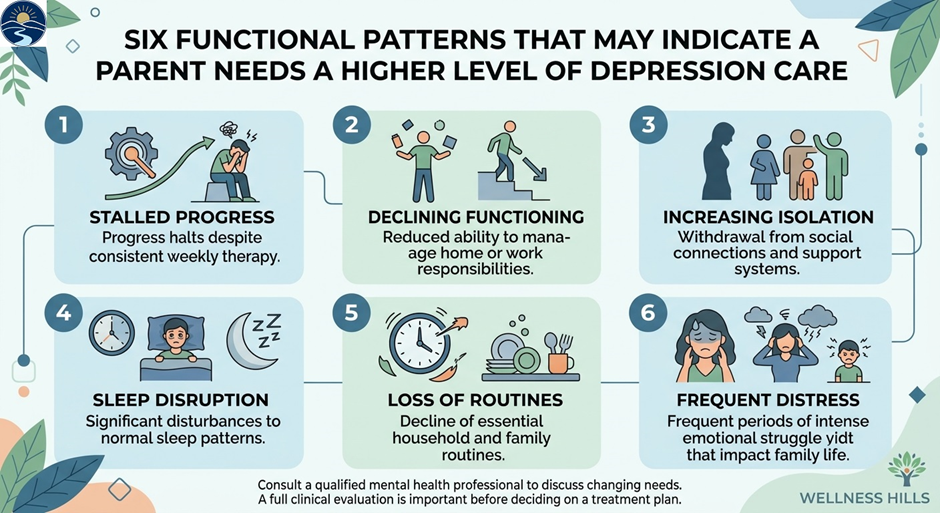
These patterns don’t automatically mean that IOP or PHP is necessary. They are reasons to discuss changing needs with a qualified mental health professional.
For parents experiencing both depression and anxiety, an integrated IOP may also be relevant. Wellness Hills offers a co-occurring depression and anxiety IOP in Chester with structured treatment and psychiatric support.
Postpartum depression can require its own clinical considerations, while people experiencing bipolar depression may need treatment planning that accounts for the broader bipolar disorder. A diagnosis and clinical evaluation are therefore important before selecting a treatment approach.
How Treatment Supports the Whole Family
A parent receiving mental health care is still a parent. Families searching for Wellness Hills Chester, NJ will find a full continuum of care at the Chester location. Treatment doesn’t erase caregiving responsibilities, but it can give a parent structured time to address symptoms that are making those responsibilities harder to manage. That may involve learning strategies for emotional regulation, rebuilding routines, improving communication, addressing sleep problems, or reviewing medication with a psychiatric provider when appropriate.
This is where personalized treatment becomes particularly relevant. At Wellness Hills Mental Health Treatment in New Jersey, care is described as individualized, with treatment plans developed around clinical needs and reviewed as progress develops. The center offers outpatient, IOP, and PHP levels of care in Chester, giving clinicians different levels of structure to consider depending on the person’s circumstances. Wellness Hills Mental Health Treatment is located at 425 Main Street, Floor 1, Chester, NJ 07930.
For a parent, that flexibility can matter. Treatment needs to address the clinical condition while recognizing that family schedules, employment, school transportation, household responsibilities, and caregiving can’t always be placed on hold. The broader lesson for families is simple: parental mental health is part of family wellbeing. Supporting a parent’s treatment isn’t separate from supporting the household.
What the First Step Actually Looks Like
The first step doesn’t have to be a commitment to a particular program. For someone considering Wellness Hills mental health treatment New Jersey options, the process can begin with a confidential conversation about symptoms, current functioning, treatment history, and what is happening at home. Insurance verification can help clarify coverage, while a clinical and psychiatric evaluation can provide a more informed basis for determining the appropriate level of care.
Wellness Hills Mental Health in Chester, NJ provides depression treatment with psychiatric oversight and a multidisciplinary clinical team. The center is accredited by The Joint Commission and licensed by the New Jersey Department of Health. For families in Chester, Morris County, and surrounding New Jersey communities, understanding the available levels of care can make the idea of seeking treatment feel more practical.
A parent doesn’t have to wait until family life becomes unmanageable before asking what support is available. Sometimes the most constructive step for a household begins with recognizing that the parent’s mental health deserves attention too.
Call Wellness Hills Mental Health Treatment at (973) 532-5139 to discuss treatment options and verify insurance benefits. There is no commitment required to start the conversation.
About Wellness Hills
Wellness Hills Mental Health provides outpatient mental health services in Chester, New Jersey, including individual and group therapy, psychiatric care, medication management, intensive outpatient programming, and partial hospitalization programming for adults.
Its approach emphasizes individualized treatment planning and matching the level of care to each person’s clinical needs.