
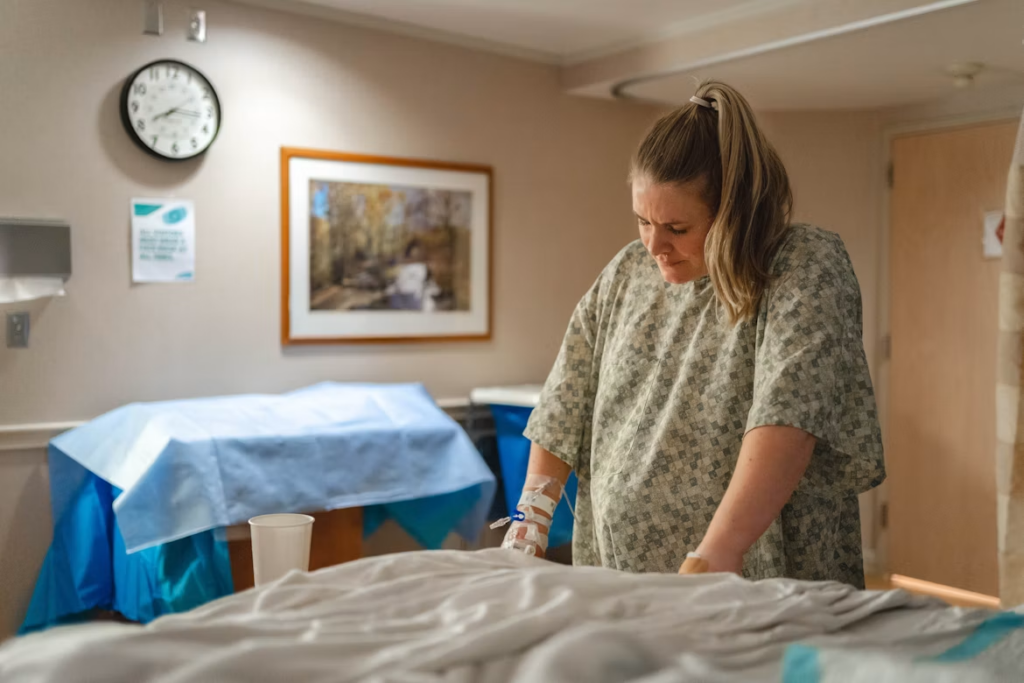
Ever wonder what those two belts around a labouring mum’s tummy are doing?
Most parents don’t.
They’re applied and the machine begins spitting out a squiggly line on a paper strip and people resume their conversations about names for babies. It joins the general hum of medical machinery.
Yet that squiggly line is about all there is to tell anyone how the baby is doing in labour. And labour is tough on a baby. Each contraction compresses the placenta and momentarily reduces oxygen flow. If the baby is strong she will tolerate it just fine.
A struggling baby doesn’t.
Here’s the part most parents never hear…
The machine doesn’t save babies. The people reading the machine save babies.
What’s covered below:
- What Continuous Monitoring Actually Does
- The Warning Signs Hiding In That Wobbly Line
- What The Research Really Shows
- When Nobody Is Watching The Strip
What Continuous Monitoring Actually Does
Continuous electronic fetal monitoring, often abbreviated as EFM or CTG, traces two separate measurements simultaneously. The fetal heart rate. Uterine contractions.
On their own, neither number means very much. Printed together, they tell a story.
Plus, this tech is everywhere. It’s used in nearly 90% of labours in America. Meaning there’s a really good chance it will be used during yours.
And that’s why that story is so important. If a baby’s heart rate falls at the wrong time, it’s communicating to staff that there’s a problem. The strip is evidence of what medical staff knew at what point in time. That’s why it’s the first thing a birth injury lawyer requests when parents ask why their newborn was injured during birth. They’ll show if concerns were addressed or ignored for hours on end. Families who want to learn how a birth injury claim is built around those printouts can click here.
OK. That’s the paper part of the deal. Now back to the reality of the delivery room.
The Warning Signs Hiding In That Wobbly Line
A monitor strip is more than a beat counter. It has rhythms, and people trained to watch for a few specific ones.
The main red flags include:
- Late decelerations — the heartbeat slows after a contraction has finished rather than recovering with it. This may indicate that the placenta isn’t providing enough oxygen.
- Loss of variability — a healthy trace should be a little bumpy and jagged. A flat smooth line is usually a sign that the baby is no longer responding normally.
- Prolonged bradycardia — a lower-than-normal heart rate that remains depressed for minutes rather than seconds.
- Fetal tachycardia — rapid heart rate, suggesting infection or distress.
None of them individually demonstrates that a baby is being abused. That’s the real issue at stake there. That’s a good point. That is where much of the debate in ob sits.
Reading a strip is an art, not math. You can have two skilled doctors look at the same printout and come up with two different interpretations.
Which brings us to the honest part…
What The Research Really Shows
Continuous monitoring doesn’t work magic, so far the evidence is mixed is fair.
The biggest analysis of the studies discovered that continuous monitoring halved newborn seizures compared to intermittent listening. That is a tangible benefit for infants.
However the same review did not find evidence of reduced cerebral palsy or infant deaths and it did find an increase in caesarean sections and forceps deliveries.
Why the mismatch?
This is because the monitor is super effective at detecting POSSIBILITY of distress but not effective at detecting CONFIRMED distress. One study showed the false positive rate was 99% when checking oxygen levels.
The tool is delicate. Extremely delicate. It screams frequently and almost never something is actually wrong.
And that creates two very different risks:
- Staff overreact to a normal trace and rush a mother into unnecessary surgery.
- Staff become accustomed to shouting so much that they ignore it when a baby actually needs assistance.
The second one is silent killer. Which is why continuous monitoring is more important than most parents understand. A strip doesn’t do you any good if nobody is watching it and responding accordingly.
When Nobody Is Watching The Strip
Here’s something that surprises a lot of first-time parents…
Labour wards fill up. Nurses are responsible for multiple rooms. Shifts rotate. Monitors continue printing regardless of someone reading them or not.
Oxygen deprivation during labour doesn’t come with sirens and screaming. It presents itself as a pattern on paper, and can creep up over an hour or more before anything overt occurs.
That lag time is when permanent damage can occur. An infant brain requires oxygen to function. Miss enough oxygen, and you risk seizures, brain damage, or permanent motor deficits. Cerebral palsy is the most common motor disability of childhood. It impacts approximately 3.1 per 1,000 children in the United States.
Not every case is preventable. Plenty have nothing to do with labour at all.
However, some strips do. And when they do, often times the discrepancy between when a warning was clearly printed on the strip and when someone finally took action on it is where things started to go south. It is also why a birth injury attorney will immediately want to go back to the printout because the timeline of events on paper doesn’t always correlate with the timeline in the notes.
A good labour ward gets three things right:
- Someone reviews the trace regularly, not occasionally
- Concerning patterns get escalated to a senior clinician straight away
- The decision to deliver quickly gets made in minutes, not hours
Questions Worth Asking Before Labour Starts
You don’t have to be a brain surgeon yourself. Just ask a few intelligent questions at your antenatal appointments.
- Will monitoring be continuous or intermittent, and why?
- Who is responsible for reviewing the trace, and how often?
- What happens if the pattern becomes concerning?
- How quickly can an emergency caesarean be performed here?
No one becomes a complaining patient by asking these questions. It means you are listening, and this situation needs listening.
Putting It All Into Practice
Continuous monitoring during labour is an aid, not a crutch. It picks up trouble early and confirms events poorly, so the humans in the room matter most.
To quickly recap:
- The strip tracks the baby’s heart rate against contractions
- Late decelerations and a flat trace are the patterns that matter most
- Monitoring halves newborn seizures but throws up a lot of false alarms
- The danger sits in the gap between a warning and a response
- Asking a few questions beforehand costs nothing
Most births are fine. Most strips are boring. But when a baby really is in distress, that squiggly line is the first indicator anyone has—and someone needs to be watching it. When it’s missed, that same strip is the documentation a birth injury lawyer will work from decades later.